Vision plays an important role in sports performance, especially in activities that require fast reactions, accurate depth perception, object tracking, and spatial awareness. Because of this, athletes diagnosed with amblyopia may wonder whether reduced vision in one eye will affect their ability to compete at a high level.
The answer is often more nuanced than many people expect. Many athletes with amblyopia adapt extremely well and continue performing successfully, including at elite levels, by relying on compensation, training, experience, and sport-specific skills. At the same time, certain visual challenges may become more noticeable depending on the sport, the severity of amblyopia, and the degree of binocular vision impairment.
This article looks at how amblyopia may affect sports performance, which visual challenges are most relevant during athletic activities , and how athletes can manage these challenges safely and confidently. It also explains why the bigger consideration is often not whether someone can participate in sport, but how to protect the better-seeing eye while supporting long-term visual performance.
Why Amblyopia May Matter Differently In Sports
In everyday life, many people with amblyopia function very well because the stronger eye compensates effectively for the weaker one. During sport, however, the visual demands can be more intense. Fast-moving objects, rapid decision-making, accurate distance judgment, reaction timing, and spatial awareness all become more important when the athlete is under pressure and the environment is changing quickly.
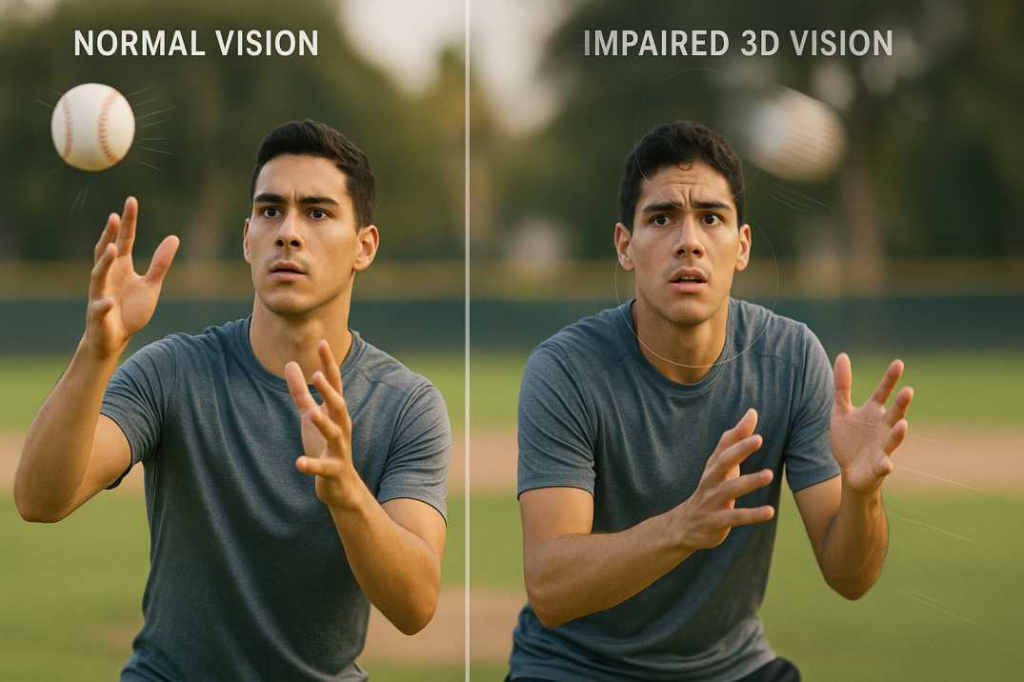
Amblyopia is commonly associated with reduced stereoscopic depth perception, which may affect sports where judging distance, timing, or the trajectory of moving objects is especially important..
This does not mean athletes with amblyopia cannot perform well. Rather,the effect of amblyopia may become more noticeable during sport-specific tasks, especially those requiring rapid three-dimensional judgment or precise binocular vision.
How Sports Performance May Be Affected
The impact of amblyopia in sport is usually not on overall athletic ability. Instead, it relates how vision supports certain types of tasks during play.
Athletes with amblyopia may experience :
- Reduced depth perception when catching, throwing, hitting, or intercepting moving objects
- More difficulty judging the speed, distance, or trajectory of a ball
- Extra visual effort in fast-paced or constantly changing visual environments
- Greater reliance on anticipation, positioning, and learned movement patterns rather than automatic binocular judgment
- Less visual reserve if the stronger eye becomes tired during prolonged activity
In practice, some athletes may notice little difference in endurance sports or activities with fewer rapid visual demands. Others may find ball sports, racquet sports, or fast-paced team sports more challenging. This is why the type of sport often has a greater influence than the diagnosis itself.
Sports Where The Challenge May Be Greater
Some sports place greater demands on binocular vision and precise depth judgment than others. Although amblyopia does not prevent participation , certain visual tasks may require more conscious effort.
These challenges may be more noticeable in:
- Ball sports that require catching, passing, or intercepting moving objects
- Racquet sports, where timing and distance judgement are critical
- Sports involving rapid changes in direction and crowded visual environment
- Activities that require very precise spatial judgment at speed
By comparison, many athletes adapt well in sports where success depends more on physical conditioning, tactical awareness, repeated movement patterns, or well-practised visual cues that rely less on moment-to-moment stereoscopic vision.
Adaptation Can Be Remarkably Effective
Many athletes with amblyopia develop excellent compensatory strategies over time. If one eye has been weaker since childhood, the brain often learns to maximise information from the stronger eye while relying more heavily on alternative visual cues.
These adaptations may include:
- Improved anticipation of movement
- Greater use of motion cues
- Better body positioning
- Increased reliance on repetition, experience, and timing
This matters because sporting performance depends on much more than stereoacuity alone. Physical conditioning, technical ability, reaction time, tactical understanding, and consistent training all contribute significantly to athletic success. Although amblyopia may influence how vision functions during sport, it does not determine an athlete’s potential.
Where Amblyopia May Matter More In Sport
| Visual demand | How amblyopia may affect it |
| Depth perception | May be less precise, especially in ball or racquet sports |
| Tracking fast-moving objects | May require greater visual effort effort in dynamic play |
| Spatial judgment under pressure | May feel less automatic in crowded or rapidly changing situations |
| Endurance or repetitive movement sports | Often less affected in many athletes |
| Overall performance | Influenced by the type of sport, individual adaptation, and skill, rather than the diagnosis alone |
The biggest Issue: Protecting The Stronger Eye
For many athletes with amblyopia, the biggest concern extends beyond performance alone. If one eye provides most of the functional vision, an injury to that eye could have a much greater effect on daily life and future sport participation.
For this reason, protecting the stronger eye is particularly important, especially in sports where eye injuries are more likely to occur.
Why Sports Eye Protection Matters More Here
Protective eyewear becomes especially important when for athletes who rely predominantly on one eye for vision. is functionally dependent on one
Depending on the sport, appropriate protection may include:
- Properly fitted sports eye guards
- Prescription sports protective eye wear if needed
- Protective eyewear that fits securely and comfortably during activity
The goal is not only to support current performance but also to reduce the risk of serious eye injury and help preserve long-term vision.
What Coaches And Parents Should Keep In Mind
Athletes with amblyopia may not always recognise or describe visual difficulties clearly. Instead, they may simply look less confident during certain drills or become more cautious when reacting to fast-moving objects.
Coaches and parents should pay attention to:
- Whether certain drills consistently appear more difficult than others
- Whether timing and distance judgement seem more challenging than physical ability
- Whether confidence decreases during visually demanding situations
- Whether appropriate eye protection is worn consistently
The aim is not to unnecessarily limit participation unnecessarily, but to create an environment that supports both safer and realistic expectations.
When A Visual Review May Be Helpful
A comprehensive eye assessment may be worthwhile l if the athlete:
- Has more difficulty than expected with ball tracking or distance judgement
- Experiences headaches or visual fatigue during training or competition
- Has not had the stronger eye examined recently
- Requires an updated spectacle or contact lens prescription
- Is progressing into more competitive or higher-risk sporting activities
Regular eye examinations can help optimise visual function, monitor the health of the stronger eye, and ensure appropriate protective measures are in place.
Conclusion
Amblyopia in high-performing athletes can present certain visual challenges, particularly in sports that rely heavily on depth perception, binocular vision, and rapid visual tracking. However, many athletes adapt exceptionally well and continue competing successfully through consistent training, experience, and effective compensatory strategies.
Understanding how amblyopia may influence sports performance allows athletes, coaches, and families to make informed decisions about training, eye protection, and long-term visual health, while recognizing that athletic success depends on far more than vision alone.
For individuals with amblyopia or concerns about how vision may affect sporting performance, assessment by an ophthalmologist can help identify any visual limitations and recommend appropriate management based on individual needs. Eye doctors such as Dr. Shamala Ganesan, Consultant Ophthalmologist, provide comprehensive eye assessments and personalised advice on visual function, eye protection, and ongoing eye care to support both everyday activities and sports participation.