Traditional amblyopia treatment has long focused on methods such as glasses, patching, and atropine therapy. In recent years, researchers have also explored newer approaches that aim to improve how the brain processes visual information. One of these approaches is known as perceptual learning.
Perceptual learning is based on the idea that repeated visual practice may help strengthen certain visual processing abilities over time. Because amblyopia involves changes in how the brain interprets visual input from the weaker eye, researchers have investigated whether structured visual training tasks may support aspects of visual recovery alongside conventional treatment.
This article looks at what perceptual learning actually means, how it differs from older treatment models, what current studies suggest about its benefits, and where it fits into the wider amblyopia treatment plan. The key idea is that amblyopia is not only about a weak eye. It is also about how the brain has learned to process visual input, which is why training the visual system itself has attracted so much attention.
What Perceptual Learning Means In Amblyopia Care
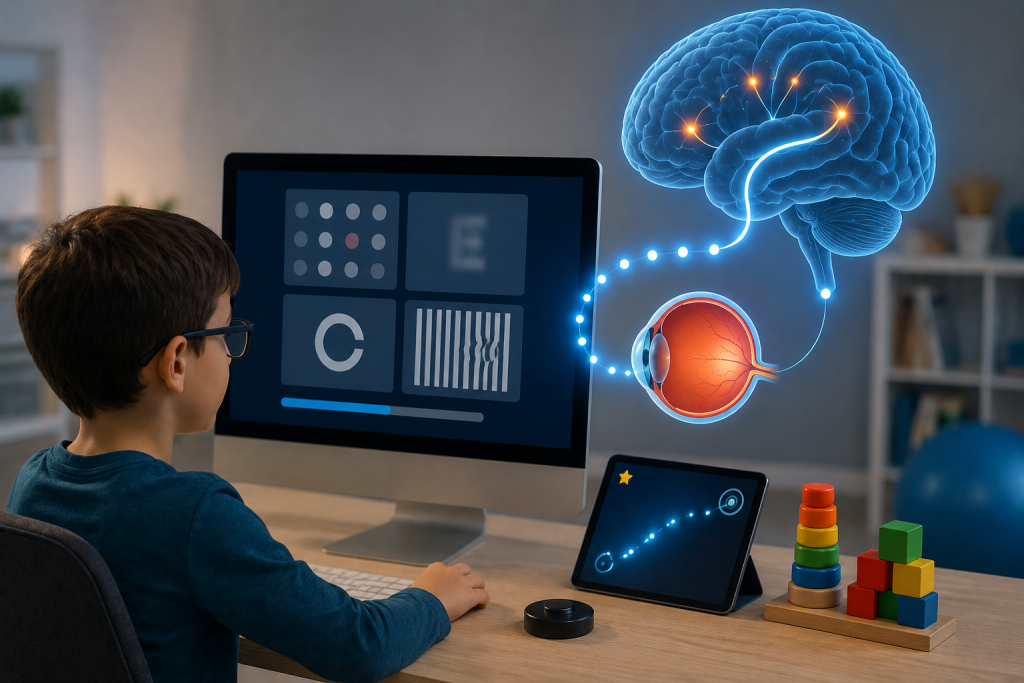
Perceptual learning refers to improvement in visual performance that happens through repeated practice on specific visual tasks. In amblyopia, these tasks may involve contrast detection, orientation discrimination, letter recognition, spatial judgement, or other controlled visual exercises. The idea is that repeated training can help the visual system become more efficient and may strengthen how the brain uses input from the amblyopic eye.
This matters because amblyopia is a neurodevelopmental disorder. The main issue is not only that the weaker eye sees less clearly. It is also that the brain has adapted to underuse its input. Perceptual learning tries to work directly on that brain-based processing side of the condition.
Why This Approach Gained Attention
Traditional treatment can improve vision well, but some patients still have residual deficits or respond less than hoped, especially at older ages. This led to interest in treatments that might still make use of neuroplasticity beyond the earliest years.
Early research showing improvement in adults through perceptual learning was important because it challenged the older belief that meaningful recovery was only possible in very young children.
How Perceptual Learning Is Usually Delivered
There is no single format for perceptual learning. Different studies and treatment systems use different tasks, though the overall principle stays similar: repeated visual practice aimed at improving visual function.
Common formats include:
- Contrast-based visual tasks
- Orientation discrimination training
- Letter or pattern recognition exercises
- Computer-based visual training
- Home-based digital programmes
- Sometimes newer forms combined with video game or binocular elements
Some programmes are monocular, which means they mainly train the amblyopic eye. Others are combined with binocular or dichoptic methods that also try to improve how both eyes work together.
What Perceptual Learning Is Trying To Improve
The main goal of perceptual learning is not only sharper letters on a chart. It may also aim to improve how efficiently visual information is processed.
Potential areas of improvement include:
- Visual acuity
- Contrast sensitivity
- Stereoacuity in some cases
- Visual discrimination
- Broader aspects of functional visual performance
This wider goal is one reason the approach remains interesting. It fits with the modern view that amblyopia affects more than one isolated measure of vision.
Perceptual Learning vs Standard Treatment
| Approach | Main idea | Potential strength | Main limitation |
| Glasses | Correct blurred vision | Essential first-line treatment | Does not always fully resolve amblyopia on its own |
| Patching | Covers the good eye to force use of the weaker eye | Well established and widely used | Difficulty in consistency, , especially with longer treatment duration |
| Atropine | Blurs the stronger eye pharmacologically | Another evidence-based standard option | Not suitable for every child |
| Perceptual learning | Repeated visual tasks train the brain’s processing of input | May improve visual function beyond visual acuity and may help residual cases | Protocols vary, evidence is still evolving, and it does not replace all standard treatment |
Where It May Fit Best In Recovery
Perceptual learning may be most useful in patients who still have residual amblyopia after standard treatment, or in older children and adults where recovery has historically been more limited. It may offer another option when improvement has plateaued after glasses, patching, or atropine.
It is not usually considered a first-line replacement for standard treatment. Instead, it may be more relevant as an additional option after the more established stages of care have already been tried.
Why Consistency Still Matters
Even though perceptual learning sounds more modern than patching, it still depends heavily on repeated and consistent practice. The treatment is based on repetition, so irregular or limited training may reduce the effect.
This means success still depends on adherence, even if the treatment looks more like structured visual training than occlusion therapy.
Conclusion
Perceptual learning represents a modern area of interest in amblyopia recovery, focusing on how repeated visual training may help improve the brain’s processing of visual information. By targeting visual perception and neural adaptation, this approach reflects a broader understanding of amblyopia as both a visual and neurological developmental condition.
While research is still evolving, perceptual learning continues contributing to the growing field of modern amblyopia rehabilitation.
Children with amblyopia or concerns about visual development should be assessed by an ophthalmologist for proper diagnosis and treatment planning. Eye doctors such as Dr. Ng Gim Leong, Senior Consultant Ophthalmologist, assesses children with amblyopia, identifies the underlying cause, and recommends suitable treatment options such as glasses, patching, atropine therapy, structured visual training, or follow-up monitoring depending on the child’s condition.