Vision is not only about how clearly the eyes see. It also involves how the brain receives, organises, and interprets visual information from the surrounding environment. Because of this, researchers and clinicians have become increasingly interested in how amblyopia may affect broader aspects of visual perception and visual processing beyond visual acuity alone.
Children and adults with amblyopia may sometimes experience differences in how visual information is processed, especially in areas involving depth perception, spatial awareness, visual attention, and coordination between the eyes and brain. These effects can vary significantly between individuals and may influence daily activities differently depending on the severity of the condition.
This article looks at how amblyopia may connect with sensory processing, what that can look like in daily life, and why the link is more about visual perception than about a global sensory disorder. It also explains why some children may appear to have challenges with coordination, attention, or confidence when the underlying issue is partly visual.
Why The Link Between Vision And Perception Matters
Vision is not only about seeing clearly. It also involves how the brain interprets visual input, combines it with other sensory information, and uses it to guide movement, attention, and behaviour. In amblyopia, uneven visual input early in life can affect more than visual acuity alone. This is why some children may seem to struggle with tasks that depend on efficient visual perception, even when blurred vision is not their main complaint.
What “Sensory Processing” Means In This Context
In this context, sensory processing does not mean that amblyopia automatically causes a full sensory processing disorder. A more accurate explanation is that amblyopia can affect visual processing, and visual processing is one part of the wider sensory system.
This relationship is usually best understood like this:
- Amblyopia affects visual input and visual processing
- Visual processing influences perception, attention, and visually guided action
- Some children may therefore show real-life challenges that look partly sensory or perceptual
That is different from saying amblyopia causes a broad sensory disorder on its own.
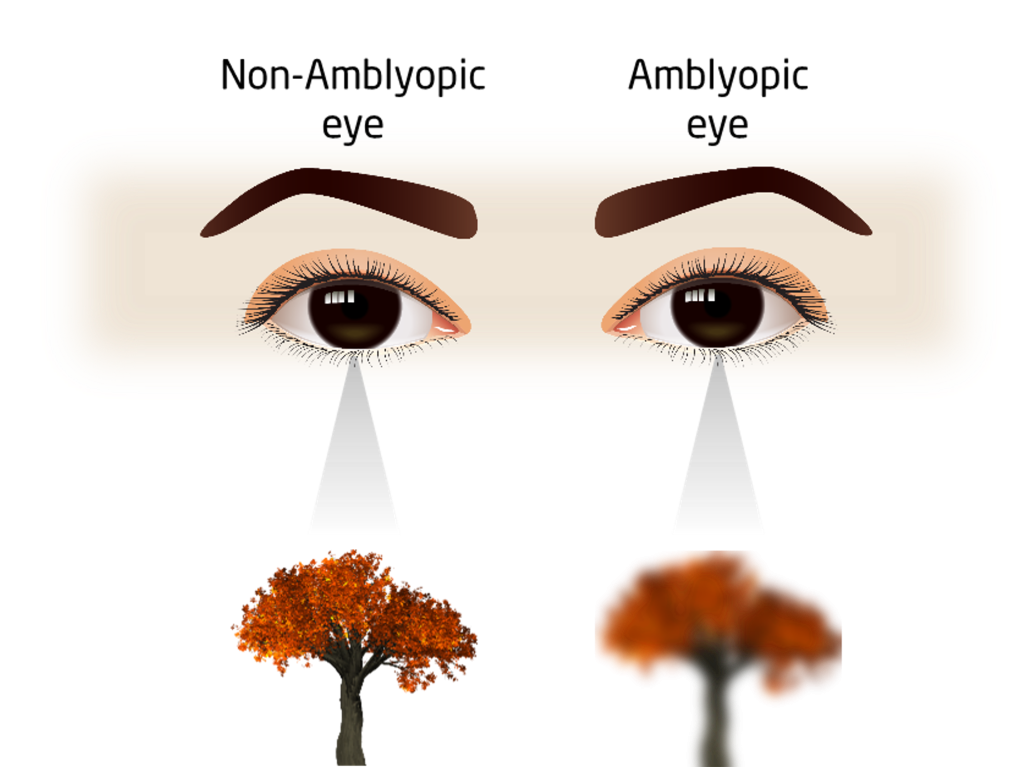
How Amblyopia May Affect Visual Perception
Research suggests that amblyopia can affect more than one aspect of perception. Beyond reduced clarity in the affected eye, studies have reported effects on:
- Visual attention
- Visual search
- Motion perception
- Global visual processing
- Binocular integration
- Visuomotor performance
This matters because a child may technically “see” an object, though still take longer to process where it is, how to respond to it, or how to coordinate movement around it.
Visual Attention And Visual Search
One of the clearer areas of research is visual attention. Some children with amblyopia may take longer to scan a scene, locate a target, or stay visually efficient during crowded or demanding tasks.
In everyday life, this may look like:
- Taking longer to find items on a busy page
- Struggling more in visually cluttered environments
- Needing extra time to copy from the board
- Seeming slower to respond in fast-moving situations
These difficulties can be easy to miss because they may look like inattention or low effort when the real issue is reduced visual efficiency.
Motion, Space, And Visual Integration
Amblyopia can also affect how the brain handles motion, space, and broader visual integration. This may help explain why some children seem less comfortable with:
- Fast-moving objects
- Crowded visual scenes
- Judging movement in sports
- Visually guided tasks that depend on timing and spacing
This does not happen in the same way in every child, but it shows why amblyopia can affect more than just one weaker eye.
Visuomotor And Coordination Challenges
Because vision helps guide movement, amblyopia can also affect visuomotor function. This may show up as:
- Clumsiness during catching or reaching
- Hesitation with fine motor tasks
- Reduced confidence in sports or playground activities
- Slower hand-eye coordination during visually guided work
These patterns do not necessarily mean the child has a major motor disorder. In some cases, they may reflect how weaker visual input affects perception and action together.
Where Vision And Perception May Overlap
| Area | How amblyopia may affect it |
| Visual acuity | Reduced clarity, usually affecting one eye |
| Visual attention | Reduced efficacy when scanning or selecting visual information |
| Visual search | Slower finding of targets in visually crowded scenes |
| Motion perception | Reduced sensitivity to moving objects or dynamic scenes |
| Visuomotor function | More effort in in visually guided hand and body movements |
| Daily perception | Tasks may feel more tiring, slower, or less automatic |
What This May Look Like At School Or Home
In daily life, the connection between vision and perception may show up in subtle ways. A child may:
- Lose their place more easily when reading
- Feel overwhelmed by busy worksheets or classrooms
- Take longer to organise and interpret visual information
- Avoid visually demanding play
- Seem less confident during tasks that require tracking or coordination
These issues can affect participation, not just performance. That is why the practical effect of amblyopia may include frustration, slower task completion, or lower self-confidence, even when the child is trying hard.
Does This Mean Amblyopia Causes a Sensory Processing Disorder?
Not necessarily. Current evidence supports the idea that amblyopia can affect visual perception and aspects of sensory integration that depend on vision, but that is not the same as saying it causes a broad sensory processing disorder in every child.
The safer conclusion is that amblyopia can influence how visual information is processed and used, and this may contribute to perceptual or functional challenges in some children.
Why This Matters For Treatment And Support
Understanding these links can help adults respond more accurately. If a child with amblyopia seems visually overwhelmed, clumsy, slow with busy visual work, or unusually tired by reading and other visual tasks, it may be worth thinking beyond acuity alone.
Some children may benefit not only from standard amblyopia treatment, but also from school support or practical strategies that reduce unnecessary visual strain. This does not replace glasses, patching, or other amblyopia-specific care. It adds useful context to how the child is functioning in daily life.
Conclusion
The relationship between amblyopia and sensory processing highlights how vision depends not only on the eyes, but also on how the brain interprets visual information. Beyond reduced visual acuity, amblyopia may influence areas such as depth perception, binocular coordination, visual attention, and spatial awareness in some individuals.
Understanding these links helps explain why amblyopia is considered both a visual and neurological developmental condition, involving visual perception as well as visual function.
Children with amblyopia may experience visual challenges that go beyond seeing clearly with one eye. In some cases, amblyopia may also affect how the brain processes visual information for reading, movement, coordination, depth perception, and confidence in daily activities. A comprehensive eye assessment can help identify whether these difficulties are related to the child’s visual development. Doctors such as Dr. Ng Gim Leong, Senior Consultant Ophthalmologist, assess amblyopia and other paediatric eye conditions, review how vision may be affecting everyday function, and recommend suitable treatment or follow-up based on each child’s needs.