Reading is one of the most important skills children develop during their school years. When a child struggles with reading, parents and teachers may first think about learning style, attention, or classroom performance. However, vision-related problems can also play a role in how comfortably a child reads and processes written information.
Children with amblyopia (commonly known as lazy eye, is a childhood vision condition where one eye does not develop normal vision properly, even with glasses, because the brain relies more on the clearer eye) may sometimes experience challenges related to visual clarity, eye coordination, depth perception (the ability to judge distance and see how near or far objects are), or sustained visual tasks, which can affect reading comfort and efficiency.
This article looks at how amblyopia may affect reading in school-age children, why the problem is not only about eyesight on a chart, and what parents should pay attention to if reading starts to feel harder than expected. It also helps place this issue in context, because reading problems can involve vision, though vision problems are not the primary cause of dyslexia (a learning difference that mainly affects reading, spelling, and processing written language) or most learning disabilities.
Why Reading Can Be Harder For Some Children With Amblyopia
Reading is a complex visual task. A child has to keep both eyes aligned, move them accurately across words, sustain attention, and process what is being seen quickly enough for reading to feel smooth. In amblyopia, vision may not simply be weaker in one eye. The condition can also affect binocular function, eye movement control, and visual efficiency during tasks such as reading.
This helps explain why a child with amblyopia may not only complain of blur. They may also:
- Read more slowly than classmates
- Lose their place more easily
- Make more frequent pauses
- Tire faster during reading or homework
- Feel less confident during classroom reading tasks
These patterns are supported by multiple studies showing that children with amblyopia can have slower reading speed and altered eye movement patterns during reading.
What Research Shows About Reading Speed
Research suggests that school-age children with amblyopia may read more slowly than children without amblyopia. Studies have shown slower reading speed, along with patterns such as increased saccades, which are quick eye movements, and less stable fixation during reading.
This does not mean every child with amblyopia will have major academic difficulty. However, it does suggest that reading may take more effort, and a child may seem tired, distracted, or reluctant during longer near tasks even when they are genuinely trying.
It Is Not Only About Visual Acuity
Amblyopia-related reading difficulty is not explained by visual acuity alone. Research suggests that some children may also show less efficient eye movement patterns during reading, including more saccades and fixations.
In practical terms, a child may be able to identify letters on a vision chart and still find reading tiring or effortful. This is because the visual system may not be handling the reading task as smoothly as expected, even when the child does not describe the problem as blurred vision.
What This May Look Like At School

In the classroom, these issues can be quite subtle. A child may not say that reading feels visually difficult. Instead, adults may notice patterns such as:
- Slower reading aloud
- Losing place on the page
- Skipping lines or words
- Reduced interest in longer reading tasks
- Frustration with homework or board work
- Fatigue later in the school day
These signs are not specific to amblyopia, but they can fit the kinds of functional reading difficulties some children experience.
Eye Movement And Tracking May Play A Role
Reading depends on accurate and efficient eye movements. Several studies suggest that children with amblyopia make more saccadic fixations and show less stable eye movement patterns during reading. This does not mean they cannot learn to read well. It means the visual side of reading may require more effort and may feel less automatic.
That extra effort can then show up as slower reading speed, more frequent pauses, or visual fatigue. In daily life, it may look like the child simply needs more time to complete reading tasks, especially when the text is dense or the activity continues for a long time.
How Amblyopia May Affect Reading
| Area | What it may look like |
| Reading speed | Reading may be slower than expected for the child’s age |
| Eye movements | More fixations or less efficient tracking across the page |
| Visual comfort | Reading may feel tiring, especially later in the day |
| Sustained attention | The child may lose place or take more breaks |
| Classroom performance | Board work, reading aloud, or homework may feel more effortful |
These patterns do not prove a child has amblyopia-related reading difficulty on their own, though they can be helpful clues when considered alongside the child’s vision history.
Does This Mean Amblyopia Causes Learning Disabilities?
This is where the explanation needs to stay careful. Vision problems can interfere with the process of learning, including reading comfort and efficiency, but they are not the cause of primary dyslexia or most learning disabilities. That distinction is important because a child may have amblyopia and also have another learning issue, though one does not automatically explain the other.
So if a child is reading slowly, the right question is not, “Is this all caused by amblyopia?” It is, “Could amblyopia be one factor making reading harder?” In some children, the answer may be yes. In others, reading concerns may also need a broader educational or developmental assessment.
Why This Matters Emotionally As Well
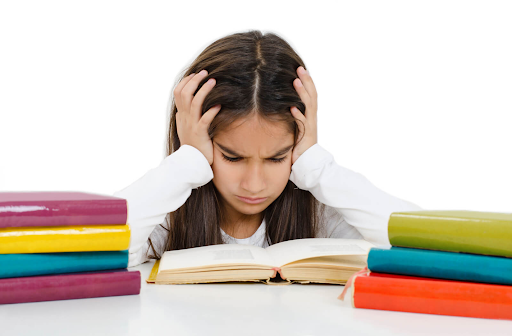
Reading difficulty is not only an academic issue. For school-age children, it can also affect confidence, classroom participation, and self-perception.
This matters because a child who avoids reading may not simply be uninterested. The task may feel slower, more tiring, or more frustrating than it does for classmates. That is why it helps when parents and teachers notice these patterns early and do not assume the problem is only about effort.
When To Look More Closely
A child with known amblyopia may need closer review if parents or teachers notice:
- Slower-than-expected reading
- Frequent loss of place on the page (Often losing track of the line or word while reading)
- Tiredness during homework
- Complaints of blur or discomfort while reading
- Reluctance to read aloud
- Growing frustration with school-based near work
These signs do not automatically mean the treatment is failing. They may simply show that the child needs a visual review, classroom support, or a closer look at how reading is functioning in daily life. Eye evaluation throughout childhood remains important because vision issues can affect fine visual tasks, even when they are not obvious at first.
For children with suspected amblyopia, a history of childhood eye problems, or reading-related visual concerns, parents may consider an assessment with an ophthalmologist, such as Dr. Nazrah Mohamed Ramli is listed as a Consultant Ophthalmologist.
Conclusion
Amblyopia may contribute to reading difficulties in some school-age children because visual clarity, eye coordination, eye movement control, and sustained near focus all play important roles in reading performance. While amblyopia does not directly cause learning disabilities, visual discomfort and reduced visual efficiency may affect how comfortably a child manages reading tasks.
Understanding this connection highlights the importance of early vision assessment and appropriate support during childhood development.